

Restros Revenue Intelligence Layer: The Missing Link in Modern Restaurant Tech Stacks
Discover how Restros connects your digital tools into one intelligent revenue layer that turns everyday data into measurable profit.

The Scaling Problem Hidden Inside Modern Restaurant Tech
The common response to fragmentation in restaurant technology has been to build more integrations or wait for native connectors to emerge. On the surface, this appears logical: if systems do not communicate, connect them. However, this approach assumes a level of stability and uniformity in restaurant tech stacks that no longer exists.
Restaurant groups today operate across geographies with distinct platform ecosystems. A brand expanding from Southeast Asia into the Middle East encounters entirely different delivery infrastructures, marketing tools, and consumer behaviors. Operators in Australia rely on a different mix of scheduling, demand forecasting, and ordering platforms than those in North America. As brands grow, the permutations of tools multiply faster than traditional integrations can be built or maintained.
The difficulty compounds when considering that restaurant tech stacks are not static. Operators frequently switch ordering providers during expansion phases, adopt new marketing automation platforms to improve campaign performance, or introduce updated inventory workflows as supplier relationships evolve. Each transition introduces new data silos and disrupts reporting continuity. Integrations that functioned previously begin to degrade, creating blind spots across revenue channels.
At the same time, restaurants are not seeking simplification through consolidation. They are seeking precision. Operations teams want tools optimized for scheduling accuracy and cost control. Marketing leaders prioritize platforms that enable segmentation and real-time engagement. Growth teams demand granular performance data across direct and third-party ordering. The preference is increasingly toward best-of-breed solutions rather than monolithic systems.
What emerges from this modular approach is not a shortage of integrations, but a shortage of unified intelligence. Connecting systems does not automatically create alignment. Data may move between platforms, yet remain fragmented in interpretation. Revenue signals become dispersed across ordering, delivery, marketing, and inventory systems without a central layer capable of synthesizing them.
As restaurant ecosystems become more modular and geographically diverse, scaling effectively requires more than connectivity. It requires orchestration at the intelligence level - the ability to transform distributed operational signals into a coherent, revenue-driven view of performance. Without this layer, complexity increases faster than clarity, and growth introduces fragmentation rather than momentum.
Introducing the Restros Revenue Intelligence Layer
The Restros Revenue Intelligence Layer is an orchestration and intelligence layer that connects ordering, delivery, marketing, inventory, and analytics systems to create a unified revenue view across a restaurant’s tech stack.
Restros connects to the platforms operators already use for online ordering, delivery aggregation, campaign management, and inventory tracking. It pulls operational and transaction-level data from these systems in real time, standardizes the data structure, and synchronizes it across connected tools. The output mirrors what a native integration would provide, while preserving the logic and format required by each platform. Operators continue to use their preferred systems, but with aligned revenue signals flowing between them.
The Revenue Intelligence Layer is used when restaurant groups choose specialized tools that do not natively communicate. It becomes particularly relevant when brands expand into new regions with different delivery ecosystems, introduce new marketing automation tools to improve campaign performance, or require inventory systems to reflect real-time ordering demand. In many cases, building direct integrations between every platform combination is neither commercially viable nor strategically sustainable.
The Revenue Intelligence Layer is not middleware that requires constant custom configuration. It does not replace existing integrations, nor does it require vendors to change their core architecture. Instead, it orchestrates revenue-relevant data flows between systems operators have already selected, ensuring that growth does not introduce fragmentation.
By integrating through Restros, technology partners gain structured access to a connected restaurant ecosystem without negotiating one-to-one integrations with every operational tool. For operators, this means faster deployment, greater flexibility in tool selection, and a tech stack that scales without compromising data continuity.
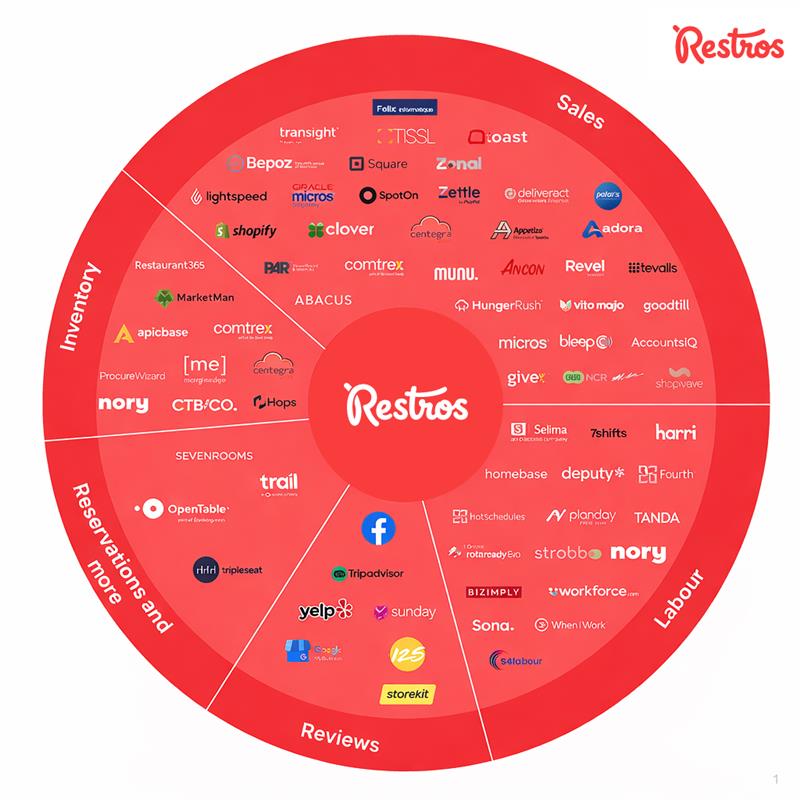
From Tool-by-Tool Integrations to One Unified Growth Engine
As Restros began working with multi-location restaurant groups across different markets, a consistent pattern emerged. Operators were not struggling because of poor tools. They were struggling because their tools were operating in isolation. Marketing platforms could not see delivery performance in real time. Inventory systems lacked visibility into promotional demand spikes. Ordering platforms captured transactions without feeding meaningful revenue intelligence back into campaign or supply decisions.
The constraint was not product capability. It was fragmentation.
Restaurant groups were increasingly selecting best-of-breed solutions for specific functions. Growth teams prioritized platforms optimized for direct ordering conversions. Marketing leaders invested in tools that enabled segmentation and automation. Operations teams adopted inventory systems aligned with supplier workflows. Each decision was rational in isolation, but collectively the stack lacked a unifying revenue perspective.
The traditional response was to build direct integrations one at a time. Connect ordering to analytics. Connect delivery to reporting. Connect marketing to customer databases. This incremental approach worked at small scale. But as restaurant ecosystems expanded across regions and channels, the permutations increased. Every new platform introduced additional data alignment work. Every geographic expansion introduced different technology standards. Each new campaign initiative created additional dependencies.
The integration model itself became the bottleneck.
Revenue intelligence depends on granularity and consistency. Sales events, demand fluctuations, promotional performance, and customer behavior must be standardized before they can be interpreted. Building and maintaining direct integrations between every tool combination proved increasingly inefficient. The time required to maintain data continuity across systems grew faster than the operational complexity it was meant to solve.
Through years of connecting ordering data, delivery metrics, inventory consumption signals, and campaign performance indicators, Restros developed a consistent internal standard for how restaurant revenue data should be structured. That standard was not tied to any single vendor or geography. It was built around operational realities: transaction-level detail, time alignment, channel attribution, and margin impact.
This foundation led to a shift in thinking. Instead of continuing to build integrations in isolation, the focus moved toward creating a unified revenue layer capable of orchestrating data flows across the entire ecosystem. Rather than solving connectivity for each pair of tools independently, the objective became to centralize intelligence in a way that could serve multiple systems simultaneously.
The challenge was not unique to one category. Marketing platforms needed ordering data to measure campaign ROI accurately. Inventory systems required real-time sales signals to prevent stock imbalances. Analytics tools depended on consistent cross-channel inputs to generate reliable forecasts. The coordination problem extended across the entire restaurant tech landscape.
Restros was built on integrations because data aggregation is fundamental to revenue optimization. Over time, that integration infrastructure evolved beyond connectivity. It became the basis for a unified growth engine — one that standardizes operational signals and distributes structured intelligence back into the systems operators rely on.
In a modular technology environment, scaling requires more than connecting tools. It requires a consistent intelligence framework capable of supporting growth across channels, markets, and operational models. The transition from isolated integrations to a unified revenue engine is not a feature expansion. It is an architectural shift designed to support long-term scalability.
Unlocking New Opportunities for Restaurant Tech Partners
The Revenue Intelligence Layer changes what is commercially and operationally possible for restaurant technology partners. It influences deal velocity, onboarding efficiency, cross-market expansion, and long-term customer retention.
In many cases, commercial conversations stall not because a partner’s product lacks capability, but because revenue data cannot flow cleanly across the operator’s existing ecosystem. A marketing automation platform may deliver strong segmentation and campaign tools, yet struggle to prove ROI if ordering and delivery data are fragmented. An inventory system may offer superior cost control, but face hesitation if real-time sales alignment requires complex integration builds. By standardizing and orchestrating revenue-relevant data through Restros, partners remove integration friction as a barrier to deal closure.
The impact extends beyond individual deals. Market expansion often depends on compatibility with the dominant technology mix in a region. A partner entering a new geography may encounter a different ordering landscape, alternative delivery channels, or varied reporting standards. Building direct integrations for each new ecosystem is resource-intensive and often commercially unjustifiable. Through the Revenue Intelligence Layer, partners gain structured access to standardized revenue signals without rebuilding their integration infrastructure for every new market combination.
Retention stability is another outcome. Restaurant groups frequently adjust components of their tech stack as they scale. They may adopt new ordering channels, refine marketing platforms, or restructure inventory systems to match supplier changes. When revenue data continuity depends on direct system-to-system integrations, every platform shift introduces churn risk. With Restros maintaining the intelligence layer, partners remain connected to revenue signals even as operators evolve other parts of their stack.
Onboarding efficiency also improves. Instead of waiting for engineering teams to develop or modify connectors for each new client configuration, partners can rely on a consistent revenue data framework already structured within Restros. This reduces implementation timelines and minimizes custom configuration overhead, allowing restaurant groups to move from contract to operational alignment with less delay.
The broader effect is strategic focus. Partners can concentrate on advancing their core product capabilities—whether in marketing optimization, demand forecasting, inventory precision, or analytics—without dedicating disproportionate resources to maintaining one-to-one integrations across an increasingly modular ecosystem.
As restaurant technology environments grow more complex, the coordination challenge becomes ecosystem-wide rather than vendor-specific. The Revenue Intelligence Layer addresses this coordination problem by standardizing and orchestrating revenue data flows across platforms operators have already selected. For partners, this creates commercial flexibility without expanding integration teams or slowing market expansion.
Operational Clarity for Multi-Channel Restaurants
Operators gain flexibility and continuity when revenue data is aligned across ordering, delivery, marketing, and inventory systems without requiring vendor consolidation. In a multi-channel environment, clarity depends on coordinated intelligence rather than reduced tooling. Restaurant groups can adopt the platforms that best serve their operational or growth objectives without being constrained by native integration compatibility, as the Revenue Intelligence Layer standardizes and synchronizes revenue signals across systems.
This continuity becomes critical during expansion, regional diversification, or vendor changes. As brands introduce new ordering channels or refine marketing and inventory tools, revenue visibility often fragments. By maintaining alignment at the intelligence layer, Restros preserves consolidated reporting, supports accurate forecasting, and reduces dependency on specific vendor configurations. The result is a unified operational view embedded within existing tools, enabling multi-channel restaurants to scale without sacrificing data consistency.
Early Performance Signals Across Ordering and Delivery
Early patterns from restaurants using the Revenue Intelligence Layer indicate measurable reductions in operational friction across ordering and delivery channels. When revenue data from direct ordering, third-party delivery, and promotional campaigns is standardized in one framework, reporting alignment improves immediately. Teams no longer reconcile inconsistent dashboards or manually stitch together channel performance before making pricing or marketing decisions.
We are also seeing faster activation during expansion phases. Brands introducing new delivery platforms or expanding into additional ordering channels are able to incorporate those revenue streams into their existing reporting structure without disrupting visibility. Instead of waiting for system-specific integrations to mature, operators gain continuity in performance tracking from day one. This compresses the timeline between channel launch and actionable insight.
The consistent pattern is that once revenue signals across ordering and delivery stop operating in silos, decision-making accelerates. Marketing teams can measure campaign impact against real transaction data. Operations teams can monitor demand shifts in near real time. As coordination improves, performance optimization becomes proactive rather than reactive, allowing restaurants to respond to channel dynamics with greater precision.
Revenue Intelligence as Core Restaurant Infrastructure
The Revenue Intelligence Layer is not Restros replacing ordering platforms, delivery systems, marketing tools, or inventory workflows. It is Restros establishing a foundational layer that enables these platforms to operate cohesively without requiring each vendor to build direct integrations with every other system in the stack.
For technology partners, the Revenue Intelligence Layer extends ecosystem reach without increasing engineering burden. A marketing platform does not need to build custom connectors to every ordering or delivery system to measure campaign performance accurately. An inventory solution does not need to delay regional growth while waiting for new channel integrations to be developed. Restros standardizes and orchestrates revenue signals so that partners can operate across diverse restaurant stacks without rebuilding connectivity for each configuration.
This approach reduces coordination pressure rather than adding to it. Partners can concentrate on improving their core capabilities—refining segmentation logic, enhancing forecasting models, or advancing operational analytics—while the intelligence layer manages structured revenue alignment across platforms. The emphasis shifts from maintaining integrations to advancing product quality.
For operators, this infrastructure eliminates forced trade-offs between capability and compatibility. Restaurant groups design their tech stacks around operational priorities, not integration constraints. They select the tools that best support ordering performance, marketing precision, or inventory control, confident that revenue intelligence will remain unified.
As restaurant ecosystems become more modular and regionally diverse, coordination must evolve from vendor-to-vendor connections to a shared intelligence framework. The Revenue Intelligence Layer functions as that framework, enabling independent platforms to contribute to a coherent revenue strategy without consolidation.
The Data Flywheel: Signals, Optimization, Growth
As restaurant operations became increasingly multi-channel, we observed a different kind of momentum taking shape. It did not begin with expansion into new regions, but with the accumulation of structured revenue signals. Every transaction across ordering platforms, every delivery event, every campaign response, and every inventory adjustment generated data. Initially, that data lived in isolation. Once standardized within the Revenue Intelligence Layer, those signals began to reinforce one another.
The effect was cumulative. When ordering data aligned with delivery performance, margin visibility improved. When campaign performance connected directly to transaction-level outcomes, optimization cycles shortened. When demand patterns synchronized with inventory consumption, forecasting accuracy increased. Each layer of alignment strengthened the next, creating a continuous loop of signal, interpretation, and refinement. Over time, optimization shifted from reactive reporting to proactive decision-making.
The Revenue Intelligence Layer now serves two reinforcing dimensions of growth: operators seeking clearer performance visibility and partners requiring structured revenue signals to power their own tools. As more platforms coordinate through a shared intelligence framework, the system becomes more resilient and more informative. Improvements in one channel enhance insights across others, accelerating learning across the entire stack.
What emerges is a compounding effect. Standardized data produces clearer insights. Clearer insights enable faster optimization. Faster optimization generates improved results, which in turn create richer signals for further refinement. Growth is no longer driven by isolated improvements in individual tools, but by the coordinated movement of the entire ecosystem.
In a modular restaurant technology environment, momentum does not come from adding more systems. It comes from aligning the signals those systems generate. The Data Flywheel transforms fragmented activity into sustained performance acceleration.
Where Revenue Intelligence Fits in the Restros Ecosystem
The Revenue Intelligence Layer is foundational to the growth architecture Restros is building across ordering, delivery, marketing, and operational systems. Restros assumes that restaurants perform better when revenue signals move freely and consistently across channels, rather than remaining isolated within individual platforms. The intelligence layer ensures that this flow remains structured even when those systems do not natively coordinate.
Much of the work Restros undertakes with restaurant groups begins with identifying fragmentation in the stack. Operators often discover gaps between ordering performance and marketing attribution, between campaign impact and margin visibility, or between demand shifts and inventory response. The Revenue Intelligence Layer becomes the coordinating framework that aligns these signals without requiring platform replacement. Similarly, when partners encounter revenue visibility gaps that slow adoption, the intelligence layer provides continuity without additional integration builds.
The broader growth model depends on this continuity. Transaction-level data informs campaign optimization. Campaign performance shapes demand forecasting. Demand patterns influence inventory planning and operational decision-making. When revenue signals remain fragmented, this cycle weakens. When they are standardized and aligned, optimization becomes compounding rather than isolated. The Data Flywheel depends on structured coordination across systems.
Restros has evolved from providing ordering and growth tools to establishing a shared revenue framework for the broader restaurant ecosystem. Each connected platform contributes signals that strengthen the overall intelligence model. The objective is not consolidation, but coordination. Restaurants choose specialized tools that best serve their operations. Those tools function independently, yet contribute to a unified revenue strategy.
The underlying thesis is straightforward: restaurant performance improves when systems coordinate at the intelligence level, and coordination does not require consolidation. Restros is designed not merely to exist within the stack, but to ensure the stack operates as a coherent growth engine.
Activate Your Restaurant’s Intelligence Layer
The Revenue Intelligence Layer is already supporting multi-channel restaurant groups and technology partners operating across diverse ecosystems. As more platforms coordinate through structured revenue alignment, the operational friction that once slowed expansion and optimization continues to diminish.
If you are a technology partner looking to extend your reach without expanding your integration overhead, the Revenue Intelligence Layer offers a structured pathway into connected restaurant ecosystems. By aligning with Restros, partners gain access to standardized revenue signals that support faster onboarding, broader compatibility, and sustained data continuity across markets.
If you are an operator managing a fragmented tech stack, we can begin with a structured audit of your ordering, delivery, marketing, and inventory systems. From there, we identify where revenue signals are misaligned and demonstrate how coordination at the intelligence layer can improve reporting clarity, forecasting precision, and channel optimization.
The next phase of the Restros ecosystem focuses on expanding structured participation—enabling partners to connect more seamlessly and operators to activate intelligence with minimal disruption. The objective is not simply better connectivity, but a more coordinated industry where growth is driven by aligned data rather than constrained by fragmentation.
If you are building, scaling, or optimizing within the restaurant technology landscape, we welcome the opportunity to collaborate. The future of restaurant performance depends on coordinated intelligence. Let’s build that foundation together.
In this article